


Stumped, Little Free Lab Library

Nick Blocha
“Y’know, when you said you were gonna do this, I thought you were stupid. But this actually looks really good.”
- Matt Fairchild
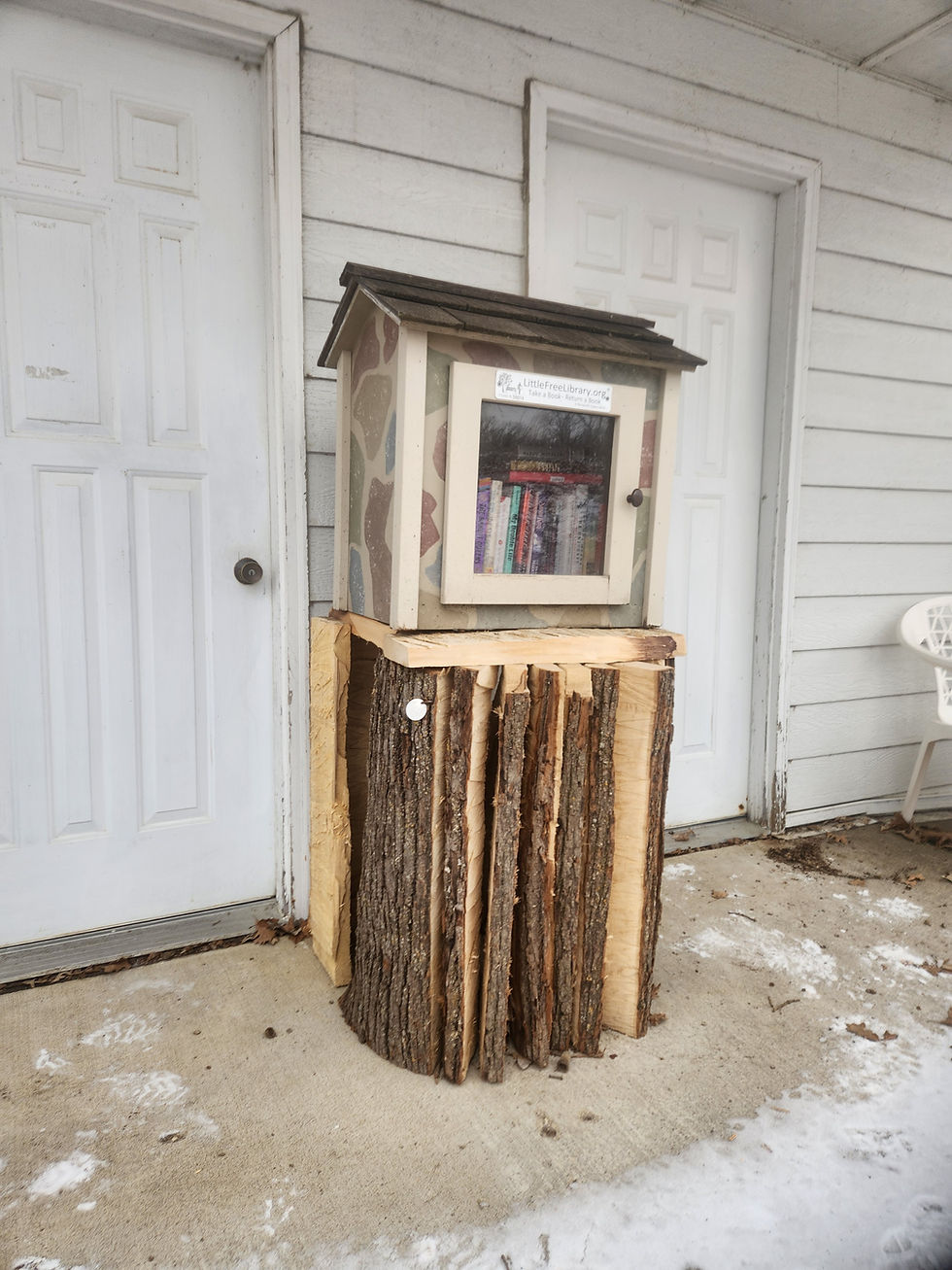
“Yeah, the coffee and grounds guys all said they really liked it,” I retorted with a smile. I’d just received what I would call a beaming compliment from our facilities manager on this little endeavor that has come to mean quite a lot to me. It was true too! I received compliments and intrigue from those faithful volunteers we see so frequently in the summer, who that Autumn day were out to pick wild onion seeds. I specifically walked us past the library, where I had just the day before finished installing the podium and secured the little free library on top, which was painted before my day to resemble the stone labs on campus built in the 1930s by the Civilian Conservation Corps.
In the summer of 2025 one of our Artists in Residence, Alexander Hanson, cleared a basswood tree which had fallen on the campus’ South-Eastern lakeside trail. Hanson has worked with chainsaws prior and just so happened to bring his along to the summer residency. From the wood, he developed an interactive art piece of “playing blocks” which remains in the same spot on that trail where the tree initially fell. It is a testament to his child and the play we mammals all require as an integral part of our process. Being the one who initially interacted with Hanson’s play space to ignite others to follow suit, as we hadn’t gotten a sign up on the spot, I was inspired to use the leftover wood that he hadn’t carved into playing blocks, and figured I could fill an offhand request at the same time, “It would be nice to have something for that little free library to sit on out there.”

I agreed with the sentiment. Few books, save for what I would stock, found their way in or out of the little stone lab looking wooden box that had been sitting on the ground, mostly empty, since I arrived in the summer of 2024. As I’m someone who has developed and enjoys exercising the muscle to look at the pieces of life and to find how things fit together (and an artist in my own right) I got to crafting. I often use what is available to me first before I head out to find something else, so I looked into what inspiration I could find from pre-cut slivers of basswood with one thin edge each still covered in bark, and curved “corners” that hosted the rough skin of the tree.

Showing the craft’s technique is a motif in my artistic work as well as Hanson’s. Especially as this art piece, which I started working on in the late fall of 2025, is specifically to be a podium for a little free library, stationed and housed at the entrance of Lakeside Labs’ historic research library, I quite easily was guided to the inspiration of a book, pages cut from trees, split and spread, yet bound within sturdy covers. This podium piece is, to me, an inspiration for our learning, and our ability to learn and grow in all things, not just from the inked words between the pages of a book, or glowing here on your computer screen and mine.

Metal identification tags were collected from other trees on campus which were set to be, and have since been, cut down to accommodate the building of the new laboratory. These tags can be found now nailed into our little free lab library podium, as well as various trees around campus from previous and ongoing research. You may even have seen some of them while out on a walk, wild or urban, near you. These tags help researchers ID a tree, since it's a lot easier to jot down 56 and 34 on a field data sheet, or the touch screen collection software, than it is to write down all the names we may give to the trees we study, relate to, and spend time with. How much longer it would take if we used the language of trees! Numbers help us collaborate and quickly transcend language barriers.

With this podium piece, sticking to Lakeside’s theme and mission of studying Nature in Nature, I invite everyone to look, to ask, and to wonder. One can wonder about the deconstruction of, and our relationship to, a tree. All trees. What names do we give them? What lives do they have? What languages do they speak? How many particles of sunlight can pass through the “skin” of a leaf in order to start photosynthesis?
Now, the Lakeside Labs’ little free library can be found full of books, and is a little more prominent and eye-catching against the white library doors. Come, find and share a novel you fall in love with, a non-fiction masterpiece that has opened your mind, early development and picture books for the kids. Science and art are all about questions and exploring answers, so keep asking, keep looking, keep doing.


About The Author
Nick Blocha is serving as a Land and Water Steward via Green Iowa AmeriCorps at the Iowa Lakeside Labs (ILL) in Milford, Iowa. Sister lab to the state hygienists in Iowa City, ILL analyzes water samples from around the state, hosts researchers and students, artists and writers, and aids in a number of environmental and community efforts with a multitude of partnering organizations and government agencies.
With a background in the arts and storytelling, and as a long-time environmental enthusiast, Nick grew up as a barefoot hippie in the woods of North Carolina and Atlanta, and values the service they can provide and assist with via the GIA program. Nick seeks to focus on the spaces where human society and nature intersect and coexist in harmony.

